

|
Menu
|
|
|
|||||||||||||||
|
|
|||||||||||||||
145
|
146 |
147 |
148 |
149 |
150 |
151 |
152 |
153 |
154 |
155 |
156 |
157 |
158 |
159 |
160 |
| La Belle France (continued). This page concludes John Fisher's selection of railway path photographs from Brittany, still exploring the narrow gauge network that radiated out from Carhaix. With the exception of the still operational line from Carhaix to Guingamp (which was converted into standard gauge and remains in use), much of this network has been converted into multi use trails. John starts with the eastern section between St Hernin-Cleden station and Landeleau-Spezet … | ||
 |
||
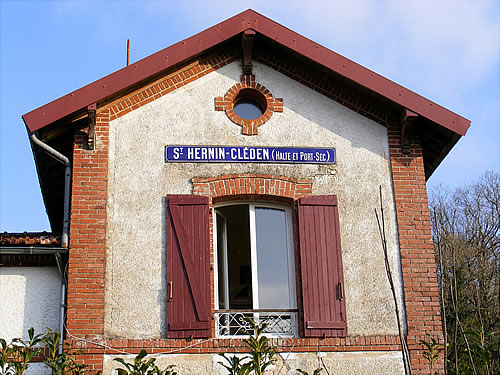
| Above: St. Hernin-Cléden station has been converted into a private residence, but still retains its blue enamelled railway sign. The style of architecture will hold no surprises if you have come to this page from Photo Gallery 72. January 2011. (John Fisher) |
||
 |
||
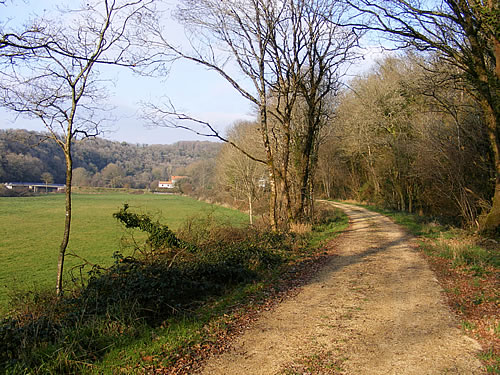
| Above: A view along the trackbed back towards St. Hernin-Cléden station, showing some of the local countryside. This is officially a 'voie verte' (green way), part of an all-over France network that normally permits pedestrians and cyclists; many of the routes are also bridleways. January 2011. (John Fisher) | ||
 |
||
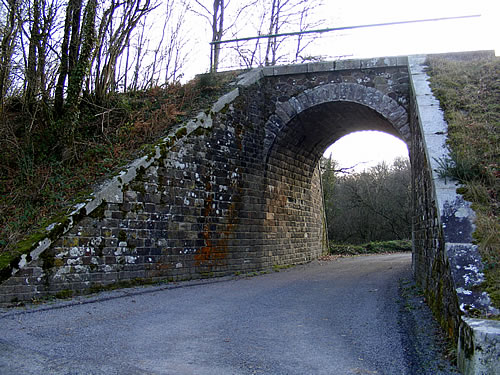
| Above: A typical overbridge on the former railway. This attractive structure wouldn't look at all out of place in Cornwall and, as on our side of the English Channel, offers the all-important 'grade separation' of walkers, cyclists and horse riders from road traffic – not that there appears to be much on this lane! January 2011. (John Fisher) | ||
 |
||
| Above: The largest engineering feature that our correspondent has encountered so far in his explorations is this substantial viaduct crossing a typically small but steep valley of a tributary of the Aulne. In view of the low clearance over the road, it is surprising that the rightmost arch has been left standing; we doubt that it would have survived in the UK, where a more cavalier attitude with disused railway infrastructure prevailed until the late 1980s. January 2011. (John Fisher) | ||
|
||
 |
||
| Above: A view of the viaduct from trackbed level. As can be seen, some attractive new parapets have been fitted to suit the structure for its new role as part of 'voie verte'. It is likely than, when used by trains, the viaduct had no parapets at all. At the time of our correspondent's visit – not the ideal time of year for a walk in the countryside – the surface either side ranged from walkable to waterlogged. January 2011. (John Fisher) | ||
 |
||
| Above: In relation to the caption above, we would say of this picture: 'Quod erat demonstrandum'! However, this quantity of water is but a trifle for a hardy British railway rambler, especially if of the late Ted Ebury's type. Faced with obstacles such as missing bridges or viaducts over rivers – commonplace in the early years of railway rambling – Ted would think nothing of taking off his socks and boots, and wading through. Now that's what we call dedication! January 2011. (John Fisher) | ||
 |
||
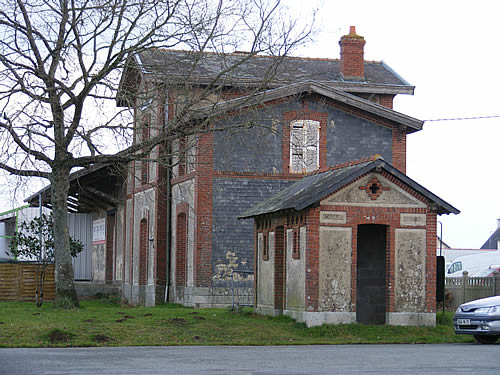
| Above: Chateauneuf station – yet another railway building in the now familiar Brittany style. Here, a road occupies the trackbed for about a kilometre. As with Snows at Glastonbury, a huge timber yard still exists alongside the former track, although the size of this is currently being much reduced. January 2011. (John Fisher) | ||
 |
||
| Above: A close-up of Chateauneuf station showing the mis-spelt name, which should be rendered as Chateauneuf du Faou. Still, who are we Brits to talk? Our railways have mis-spelled a few place names in their time as well. January 2011. (John Fisher) |
