

|
Menu
|
|
|
|||||||||||||||
|
|
|||||||||||||||
145
|
146 |
147 |
148 |
149 |
150 |
151 |
152 |
153 |
154 |
155 |
156 |
157 |
158 |
159 |
160 |
| The Somerset & Dorset Railway (continued). With 2016 being the 50th anniversary of the S&D's closure, the club's South Western Area – with help from colleagues in the Southern Area – arranged three separate walks over different parts of the old trackbed. Some sections of these walks were over private land, by prior consent of the landowners, and offered something rather special for members. Therefore, please do not assume that the publication of these photographs implies a public right of way at the locations depicted. | ||
 |
||
| Above: The club's first S&D event of 2016 took place on the 50th anniversary, to the day, of the last trains running and started with a visit to John Gartell's marvellous Gartell Light Railway, which has featured in these pages before. This is the view from near the GLR's terminus at Park lane, looking north towards Templecombe. At this location, the modern narrow gauge railway is laid directly on the old S&D trackbed. 5th March 2016. (Jeff Vinter) |
||
 |
||
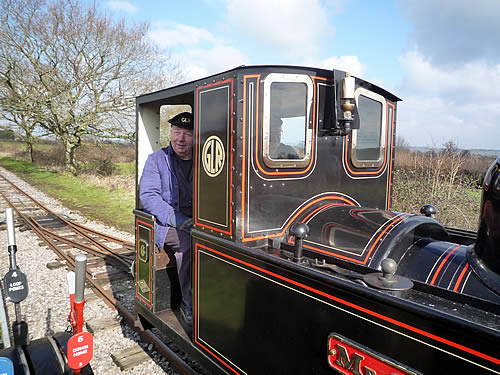
| Above: A picture of John Gartell in the cab of locomotive number 6, an 0-4-2T named 'Mr. G' after John's father, Alan. The engine was built at the North Dorset Locomotive Works at nearby Motcombe between 1993 and 1998, when it entered service. 5th March 2016. (Jeff Vinter) | ||
 |
||
| Above: Common Lane in the village of Yenston, just south of Templecombe, is the centre of GLR operations. Anyone with an interest in railway signalling will appreciate the authentic Southern Railway style upper quadrant signals, which are a labour of love by volunteer John 'CJ' Penny, a professional railwayman with a passion for signalling. This view depicts the GLR freight train, which was not in service on the occasion of our visit but is a popular feature on open days. 5th March 2016. (Jeff Vinter) | ||
 |
||
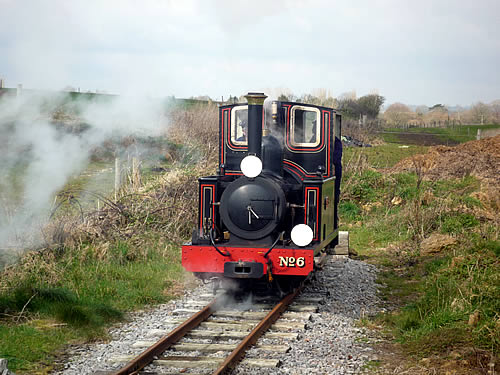
| Above: A study of No. 6 at the north end of the run-round loop at Tower View, which is the GLR's newest station, and the nearest one to Templecombe. The station is named after the distant view that it affords of King Alfred's Tower on the Stourhead Estate. The land behind the locomotive is owned by other members of the Gartell family, but no further extensions are planned. 5th March 2016. (Jeff Vinter) | ||
 |
||
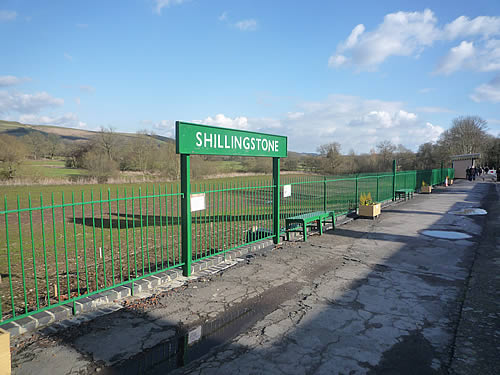
| Above: A view of the down (southbound) platform at Shillingstone, with Hambledon Hill in the background. At this point, the Shillingstone Railway Project is diverting the North Dorset Trailway off the platform to a new locatioon just behind it on the left. The intention must be to reinstate a second set of rails on the trackbed – which would restore the station's appearance to that of 50 years ago. 5th March 2016. (Jeff Vinter) | ||
 |
||
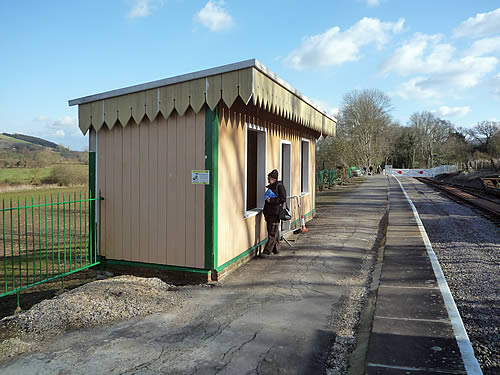
| Above: The new shelter on the platform – seen in the distance of the photograph above – was nearing completion on the occasion of our visit. This further reinstatement brings this part of the station back to its 1966 condition. 5th March 2016. (Jeff Vinter) | ||
 |
||
|
Above: USA 0-6-0 tank locomotive no. 30075 stands at the head of a two-coach train at the northbound platform of Shillingstone station in Dorset, 50 years to the day after the last BR service trains ran over the Somerset & Dorset line. The locomotive was actually out of service pending firebox repairs and a full overhaul; sister locomotive no. 30076 was also on site awaiting repairs. Both locomotives arrived at Shillingstone on Wednesday 20th January 2016 as the result of an agreement between 'Project 62', which aims to restore these locomotives, and the North Dorset Railway Trust. 5th March 2016. (Jeff Vinter) |
||
|
||
 |
||
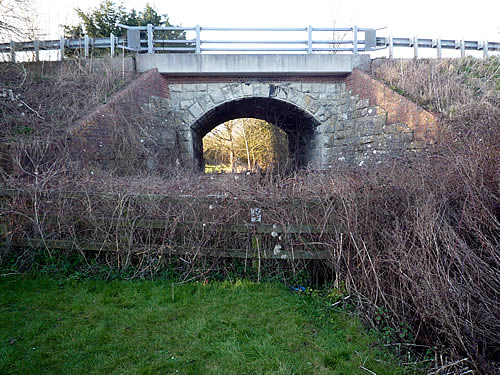
| Above: Our final visit of the day was to Henstridge, where little remains of the station – the smallest on the line – although its site has been grassed over and is now used as a small recreation area. This is the bridge at the north end of the station, still carrying the A30 between Salisbury and Yeovil. It is extraordinary to recall that express trains from as far afield as Manchester used to come storming through the arch. 5th March 2016. (Jeff Vinter) |
