

|
Menu
|
|
|
|||||||||||||||
|
|
|||||||||||||||
145
|
146 |
147 |
148 |
149 |
150 |
151 |
152 |
153 |
154 |
155 |
156 |
157 |
158 |
159 |
160 |
| The Isle of Man Railway between Douglas and Ramsey via St. John's. After we had published Neil Hebborn's photographs of the Isle of Man's lost railways (see here and here), member Robin Summerhill supplied a complementary selection of his own.photographs, which we present here. They start with a couple of shots from the still operational Isle of Man Steam Railway. |
 |
|
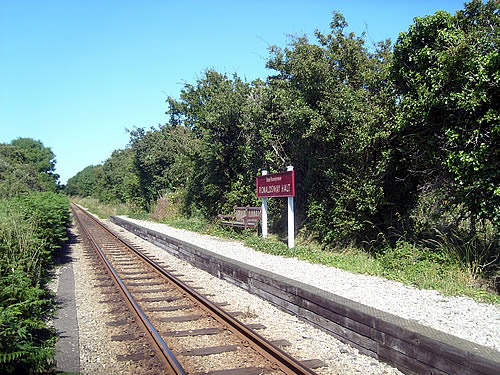
Above: Ronaldsway Halt is situated on the Isle of Man Steam railway between Ballasalla and Castletown; it is only a few hundred yards from the airport, and may well be the only airport station in the world that is a request stop. July 2014. (Robin Summerhill) |
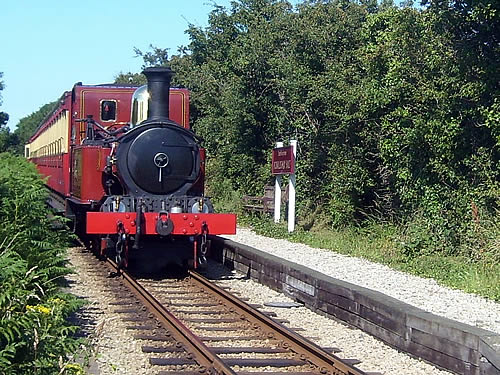 |
| Above: The 'airport express' coasts through Ronaldsway Halt in the charge of locomotive number 4, Loch, which was named after lieutenant governor Henry Brougham Loch and built in 1874 by Beyer Peacock of Manchester. The driver's face is just visible through the cab window. July 2014. (Robin Summerhill) |
 |
|
Above: This is Union Mills, the first station on the closed line from Douglas to St. John's and Peel. The station gardens here, tended by the station master and his staff, were very well known locally and frequently won the prize for the best on the island network. The rail vehicle in the middle of the picture is the railway's old breakdown crane, which was placed here on a panel of track when the island's rail trails were developed. July 2014. (Robin Summerhill) |
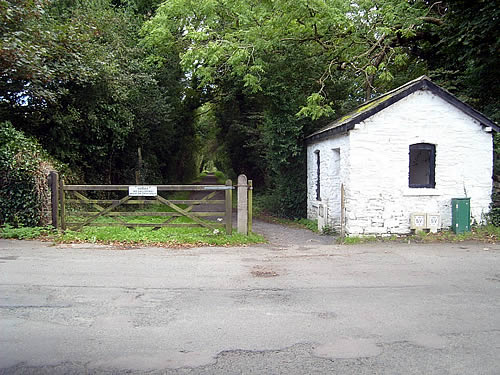 |
| Above: Continuing west along the line towards St. John's, the next station was Crosby, where the station has been flattened completely; this is the view back along the trackbed to Union Mills and Douglas. When the line closed finally in 1968, a group of Merseyside lads removed the station's running-in board, which to this day is believed to be mounted in the scout headquarters at Crosby, Liverpool. The old crossing keeper's shelter, the simple one-roomed affair seen here on the right, is now a shelter for trail users. July 2014. (Robin Summerhill) |
 |
| Above: There is not a vast amount to see nowadays at the site of St. John's station, but just to the east of it the first bridge on the Foxdale branch passes overhead on a fine stone bridge, seen here; this was the only location on the Isle of Man where one railway crossed another. The Foxdale Railway was built to support the local lead mining industry, which unfortunately began to fail shortly after the railway opened in 1891. Despite this, the line clung on to a precarious existence until 1960, with occasional passenger services running due to bus shortages – a reversal of the modern blight of 'rail replacement buses'. July 2014. (Robin Summerhill) |
 |
| Above: The parallel river bridges west of St. John's seen in rather better weather than our previouis photographer enjoyed the month before (see the seventh pohotograph on this page). This time, the bridge for the Ramsey line is on the right, while that on the Peel line occupies the foreground. July 2014. (Robin Summerhill) |
 |
| Above: This photograph shows Mill Road level crossing, Peel, at the western end of the Peel line. Note the old, tarpaulin-covered and unrestored railway carriage to the left of the water tower, behind which boats now crowd the former station site. 14th June 2003. (Robin Summerhill) |
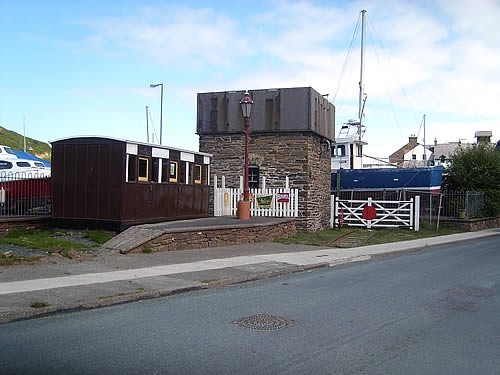 |
| Above: The same scene 11 years later. Restoration of the carriage is now complete, while a track panel has been laid in front of the level crossing to accommodate a locomotive on static display, as sometimes happens. The semaphore signal is missing because it has been removed for maintenance. Of all the closed lines on the Isle of Man, that from Douglas to Peel is the most likely to be re-opened, and to this end the Manx government has kept the trackbed clear. Although several service mains, including gas and telephone, have been laid beneath it, reinstatement has always been to a sufficiently high standard to permit the permanent way to be relaid, if ever that became a viable option. Are we imagining things, or has the manhole cover in the road moved? July 2014. (Robin Summerhill) |