

|
Menu
|
|
|
|||||||||||||||
|
|
|||||||||||||||
145
|
146 |
147 |
148 |
149 |
150 |
151 |
152 |
153 |
154 |
155 |
156 |
157 |
158 |
159 |
160 |
| Photographs by Chris Jennings. Railway photographer Chris Jennings has kindly sent us a selection of his photographs taken on club walks. His website, 'Steaming Around Britain's Railways', is well worth a look. Chris's photographs prove that there is still plenty of ruinous former railway property out there, Widnes South station being a particular eyesore. Before we get going with the 'railway ruins', we'll start with a few pictures from the short Holywell Town and Dyserth branches in north Wales, which are now attractive and popular multi use trails. |
 |
| Above: The 1¼ mile branch from Holywell Junction to Holywell Town closed to passengers on 6th September 1954, but the junction station on the LNWR line from Chester to Bangor remained open until 14th February 1966 to serve the local community of Greenfield. The former station is now a private residence, as indicated by the whirligigs in the garden. 28th March 2015. (Chris Jennings) |
 |
| Above: Just south of the junction, the branch crossed the A55 by this very substantial underbridge. The branch had already gained a lot of height in the 300 yards or so from the junction because its destination, Holywell Town, was a long way uphill. 28th March 2015. (Chris Jennings) |
 |
| Above: Looking up the grade to the site of Holywell Town station. The stone wall on the left is not the platform but the retaining wall of the former goods yard, which was situated above it and to the left. The yard was accessed by rails which passed under the left hand arch of the bridge; obviously, it had to be level, which was the one thing that the main running line was not! 28th March 2015. (Chris Jennings) |
 |
| Above: Some 10 miles to the west of Holywell Junction, the 2¾ mile branch from Prestatyn to Dyserth closed to passengers as long ago as 22nd September 1930, although various forms of freight survived until 7th September 1973. This is the site of the former rail level halt at Woodland Park (grid reference SJ 066820) on the south of Prestatyn. At Dyserth, one can continue along a trackbed which never carried rails – the half mile extension to Marian Mill which was intended to be the start of an extension on to Newmarket. 28th March 2015. (Chris Jennings) |
 |
| Above: These two underbridges are situated near the halt at Allt-y-Graig (SJ 058802), just south of Dyserth. The access path to the halt remains to this day, but is now used by walkers and cyclists making their way to and from the Dyserth Railway Path. 28th March 2015. (Chris Jennings) |
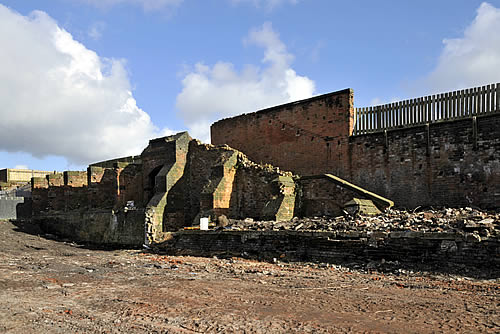 |
| Above: This is what remains at street level of Widnes South station, which closed to passengers on 10th September 1962. Behind the slope in the nearer wall are the steps to the former up platform. Amazingly, atop all this ruination is a still operational double track freight line. 23rd March 2015. (Chris Jennings) |
 |
| Above: Another shot of the chaotic scene at the site of Widnes South station. When this photograph was taken, Network Rail had just completed extensive vegetation clearance, possibly in connection with the 'Mersey Gateway' regeneration project, which – apart from providing a new bridge over the Mersey – will improve an area of over 20 square kilometres. For more photographs of Widnes South, click here. If it's scenes of ruination that you're after (and there are/were plenty of those at Widnes South), click here and here. 23rd March 2015. (Chris Jennings) |
 |
| Above: Another forlorn site that has seen better days is Boston Sleeper Works in Linconshire, which is actually 2 miles outside Boston just off the course of the modern Water Trail Way from Boston to Lincoln. The site is marked on the local OS map as 'Hall Hills'. In its heyday, this factory produced sleepers for the whole of the Great Northern Railway's extensive network using Baltic timber which arrived on site, by rail, from Boston Docks. 15th June 2009. (Chris Jennings) |
 |
| Above: Another view of Boston Sleeper Works, about which Nigel Willis, the club's founder, recently wrote a short article. 'Although Woodhall Junction to Boston closed in 1963, track remained in place for another year to serve the depot. Apart from the truncated chimney, the works are surprisingly intact and are in use for car repairs. There is no trace of the array of sidings facing the west gable ends but a dismantled LNER permanent way hut, amongst the trees, marks the spot of the junction.' 15th June 2009. (Chris Jennings) |