

|
Menu
|
|
|
|||||||||||||||
|
|
|||||||||||||||
145
|
146 |
147 |
148 |
149 |
150 |
151 |
152 |
153 |
154 |
155 |
156 |
157 |
158 |
159 |
160 |
| A North Norfolk Miscellany. The lost railway byways of north Norfolk have not been visited often by the club, but member Rob Davidson made up for this in summer 2015 by holidaying there and tracing the two old lines between King's Lynn and Wells; it is amazing how much survives. His exploration starts with a look at the former Lynn & Hunstanton Railway, which opened in 1862. |
 |
| Above: 'It's a signal box, Jim, but not as we know it'. This is what the old signal box at Dersingham looks like now that a firm of builders' merchants, Semba Trading, has been using it for a few years. Although it looks rather sad, both it and the rest of the station can be visited during opening hours. Dersingham was the half way point on the Great Eastern Railway's branch line from King's Lynn to Hunstanton. 2nd July 2015. (Rob Davidson) |
 |
| Above: The small passenger shelter on the down platform at Dersingham. Despite the proliferation of building supplies, the railway facilities appear to be in good condition. For example, the door under the canopy retains its glazing, while the canopy itself is in good order considering that it probably last saw any railway paint in the late 1950s! The King's Lynn to Hunstanton branch was a fairly late closure, finally losing its passenger services on 5th May 1969. 2nd July 2015. (Rob Davidson) |
 |
| Above: This is the well-proportioned station master's house at Dersingham which, rather unusually for an East Anglian railway station, is constructed of stone rather than the more usual brick; it is now a private residence, but can be seen clearly from the public highway. The next station to the south, Wolferton, had royal connections, so perhaps this encouraged a little extravagance in the line's buildings. 2nd July 2015. (Rob Davidson) |
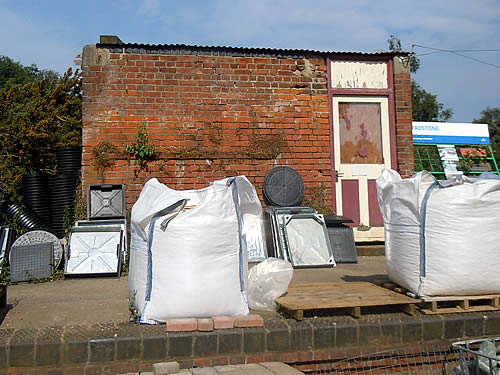 |
| Above: This rather unhappy looking structure is the lamp room at Dersingham; we wonder if it always had a corrugated iron roof. It is possible that the horizontal mark on the wall identifies where a timber batten was mounted for the station's fire buckets, although we cannot explain the two-tone brickwork. 2nd July 2015. (Rob Davidson) |
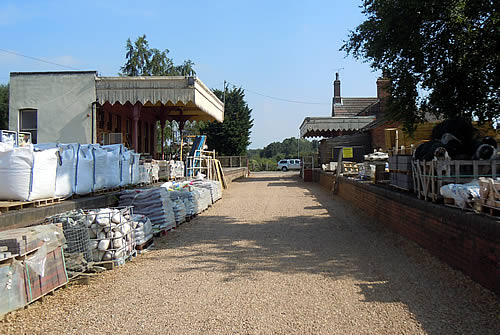 |
| Above: This view along the former trackbed, looking north towards Hunstanton, shows off most of the old station's buildings to good effect. In 1962, British Transport Films featured the King's Lynn to Hunstanton line in a short documentary film entitled 'John Betjeman Goes By Train', in which the future poet laureate sings the praises of rural branch line stations. 2nd July 2015. (Rob Davidson) |
 |
| Above: This is the companion view to the photograph above, but this time looking south towards King's Lynn. The signal box can be seen in the distance on the right. 2nd July 2015. (Rob Davidson) |
 |
| Above: The next station up the line was Snettisham, where the station master's house and station frontage can be viewed from the public highway. This was one of two stops featured in John Betjeman's railway travelogue from 1962 (see above); his other stop was at Wolferton, which served the Queen's Sandringham Estate. 3rd July 2015. (Rob Davidson) |
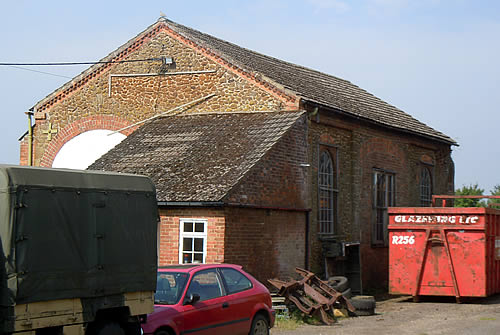 |
| Above: Snettisham goods shed still survived when our photographer visited, but we wonder for how long. Later in the year, it was being offered for sale ('offers invited in excess of £250,000') for 'redevelopment', which could mean conversion – or demolition followed by construction of something entirely new. Note the mellow stonework, which features also in the station master's houses both here and at Dersingham. 3rd July 2015. (Rob Davidson) |