

|
Menu
|
|
|
|||||||||||||||
|
|
|||||||||||||||
145
|
146 |
147 |
148 |
149 |
150 |
151 |
152 |
153 |
154 |
155 |
156 |
157 |
158 |
159 |
160 |
| The Gorseddau Tramway and Quarries. On 27th October 2019, the 'middle day' of a five-day Snowdonia walking break, members of the club's Wales and North Western groups explored the Gorseddau Tramway, a 3ft gauge railway built in 1856 to link the slate quarries around Gorseddau with wharves to the south east at Porthmadog. The line ran just over 8 miles to the Gorseddau quarries, rising 900 feet in that distance. The line was horse operated using wagons and a passenger carriage supplied by the Festiniog Railway’s Boston Lodge Works. Uphill workings would have comprised empty wagons, while down loads were worked by gravity. One of the best engineered of all slate tramways, it became one of the least used. The slate produced at Gorseddau Quarry was poor and in 1860, the peak year, the output was 2,148 tons from a workforce of 200. It fell to 865 tons in 1865 and a mere 25 in 1867, the final year. The upper section of the tramway was abandoned in about 1872, but the lower section was incorporated in a 2' gauge railway opened in 1875 to serve quarries in the Pennant Valley to the west. However, these were similarly unsuccessful and the railway had fallen into disuse by 1887. (Chris Parker and Chris Homer) |
 |
| Above: The view to the north of the Gorseddau Tramway looking over the distant Gorseddau Quarry. The scale of the enterprise is evident from the fact that the quarry has taken away a significant proportion of the mountainside. 27th October 2019. (Chris Parker) |
 |
| Above: The so-called 'Wailing Wall' (seen here looking north) overhangs the tramway at 45º as it approaches Gorseddau quarry yard. It was skilfully built at great expense, out of huge blocks of stone as a retaining wall to prevent slate waste engulfing the line – other quarries would simply have moved the tramway, but clearly Gorseddau did not think the same way as others! 27th October 2019. (Chris Parker) |
 |
|
Above: This view of the 'Wailing Wall' looking south shows the angle of the overhang to more dramatic effect. Note the blue sky in the top right of the picture: the crystal clear light in these photographs is experienced only after a prolonged period of heavy rain has cleared. In this case, the rain had lasted 36 hours and ended just 24 hours earlier. 27th October 2019. (Chris Parker) |
 |
| Above: And now some intrepid railway ramblers to give a sense of scale to this huge structure! This is a very impressive monument for an age which had no mechanical aids, as we do now. 27th October 2019. (Jane Ellis) |
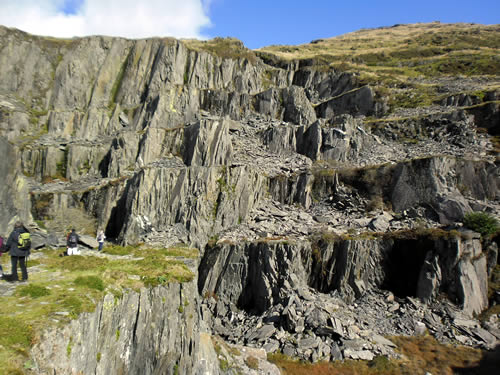 |
| Above: This view of the quarry face shows clearly the tiered approach to winning the slate; given the effort involved, it is a shame that the slate was not of better quality. 27th October 2019. (Chris Parker) |
 |
| Above: Nant-y-Pandy slate mill, seen here from the nearby road, resembles an ecclesiastical ruin. It was remote from the quarry but had a much better water supply powering a 26ft diameter overshot wheel. 27th October 2019. (Chris Parker) |
 |
| Above: The interior of Nant-y-Pandy slate mill. Slab was processed here to make such items as flooring, dairies, troughs and urinals , whereas roofing slate was dealt with at the quarry. Built at the same time as the tramway and lavishly designed and equipped, it saw little use after Gorseddau Quarry closed in 1867, although an eisteddfod was held there in 1888 and it was reputedly used as a chapel for a time. 27th October 2019. (Chris Parker) |
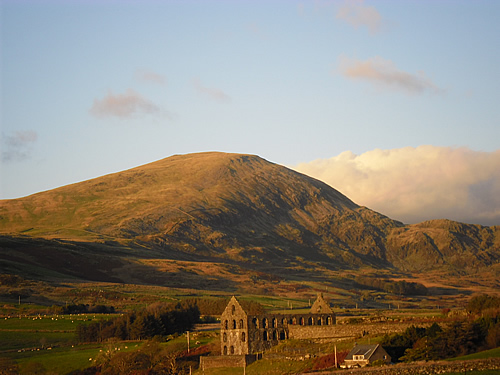 |
| Above: Our final photograph of Nant-y-Pandy mill, with Braich-y-Cornel in the background, is a perfect illustration of the romance of historical discovery, with its colours reminiscent of an oil painting by John Constable. The wood floor was removed from the mill in 1890 and the iron frame windows and slate roof in 1906. What remains is now a Grade II* listed ancient monument in the care of Snowdonia National Park. 27th October 2019. (Chris Parker) |