

|
Menu
|
|
|
|||||||||||||||
|
|
|||||||||||||||
145
|
146 |
147 |
148 |
149 |
150 |
151 |
152 |
153 |
154 |
155 |
156 |
157 |
158 |
159 |
160 |
| Rails in North Wales. Unusually, this selection of photographs from North Wales features exclusively scenes with rails – although sometimes they are invisible due to vegetation, as you'll see shortly. They start and finish with some shots of the Welsh Highland Railway, and include in between a fine selection of images by Chris Jennings, which depict the Blaenau Ffestiniog end of the old GWR branch line to Trawsfynydd. Chris's photographs are very atmospheric, but sometimes you wouldn't believe that there was a railway down there … | ||
 |
||
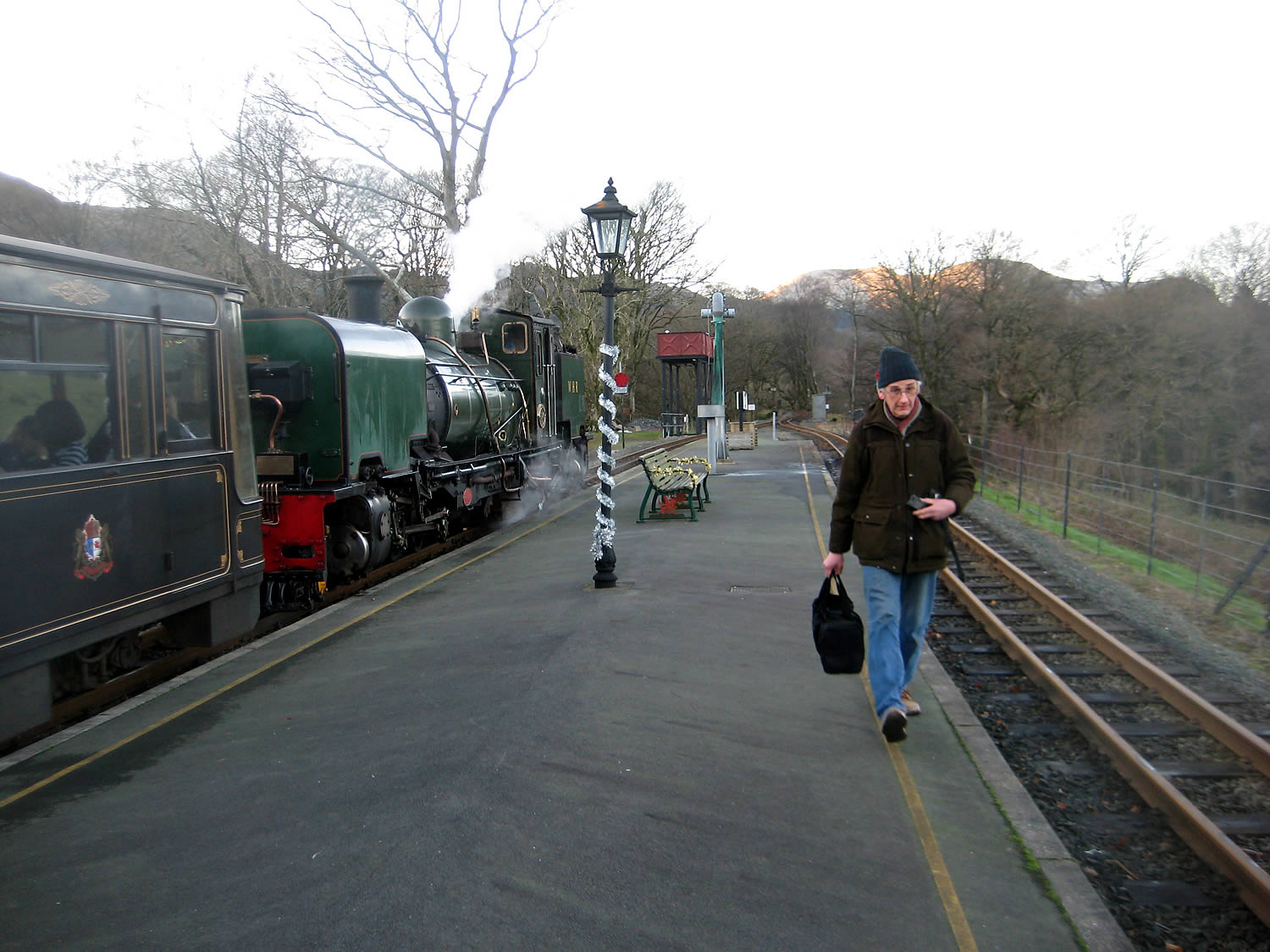
| Above: It occurred to our photographer that, often, the club's walk leaders take the pictures, so are seldom seen themselves. To rectify this, here is a picture of Chris Parker (the club's organiser in Wales) in determined mode at Beddgelert station at ca. 15:15 on 28th December 2016 during the group's 'Five Valleys Tour'. The locomotive at the head of the train is an NGG16 class Beyer-Garratt. These have a complex wheel arrangement (2-6-2 + 2-6-2 ) and were built initially for work in South Africa; they are the most powerful steam locomotives ever built for the 2 ft. gauge. 28th December 2016. (David Watson) |
||
 |
||
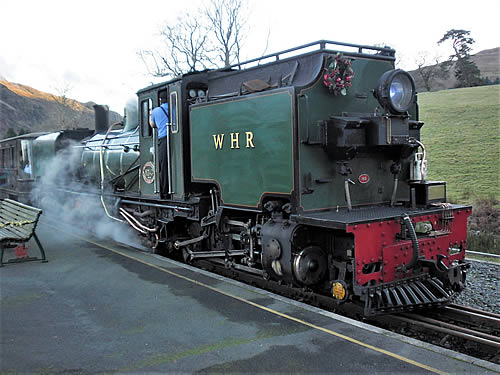
| Above: Chris, seen in the picture above, responded by supplying this shot of Beyer-Garratt No. 143 at the head of the train, which was bound for Dinas Junction. He explained that the 'Five Valleys Tour' is not a railway walk but a railway extravaganza which he organises between Christmas and New Year. There is no denying that the Beyer-Garratts are mighty engines, and it is amazing to think that the trackbed here used to be disused and walked by members of this club! 28th December 2016. (Chris Parker) | ||
 |
||
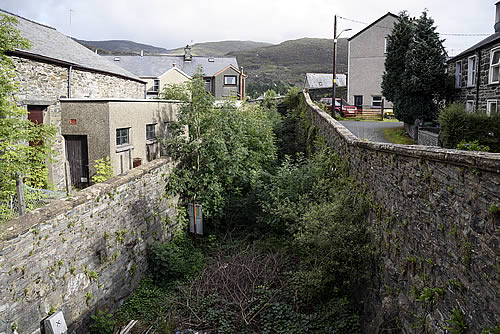
| Above: What's the connection between this photograph and the one above? If you catch a train on the Welsh Highland Railway south to Porthmadog and change there on to the Ffestiniog Railway, you can reach Blaenau Ffestiniog, which is the location here. This is just east of Blaenau station on the branch line to Trawsfynydd, which was cleared in late 2016 as part of a nascent railway preservation project. The views from this line are said to be amongst the best in the world; in other words, it isn't all like this! 2nd September 2016. (Chris Jennings) | ||
 |
||
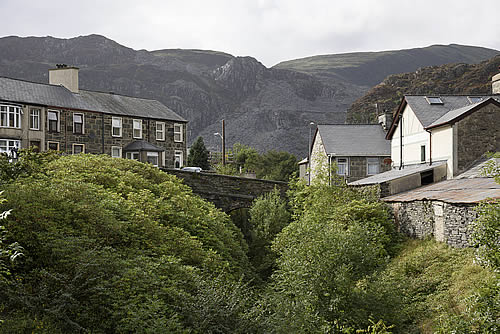
| Above: The Trawsfynydd branch at Blaenau again. There's no mistaking from the black mountain behind the terraces that this is slate country. Before the Trawsfynydd & Blaenau Ffestiniog Railway Community Interest Company came along, Snowdonia National Park had received calls to convert this route into a trail, which it is already further south around Cwm Prysor and Arenig. No doubt the costs of clearance and conversion weighed against this idea. 2nd September 2016. (Chris Jennings) | ||
 |
||
| Above: Beware low bridge. Does this underbridge at Blaenau set a record in the UK for minimum height? A Formula One racing car would have no trouble getting through, but not much else – not even a mounted cyclist! 2nd September 2016. (Chris Jennings) | ||
 |
||
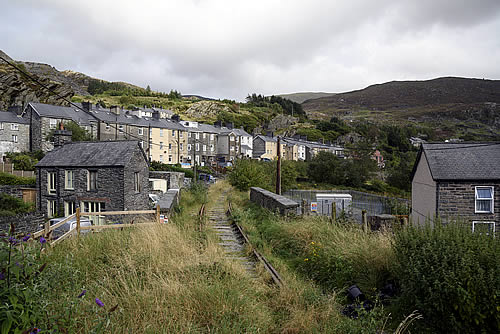
| Above: A view of the bridge above, but this time from trackbed level – a rare spot where the rails could still be seen. The branch remained in use until 1998 to serve Trawsfynydd Power Station, but although it has been disused ever since the track is protected and remains in situ. 2nd September 2016. (Chris Jennings) | ||
 |
||
| Above: A final look at this lowest of low bridges. If the Trawsfynydd & Blaenau Ffestiniog Railway Community Interest Company is successful, this bridge could once again have trains rumbling over. The group's Facebook page will be found here. 2nd September 2016. (Chris Jennings) | ||
 |
||
| Above: It would take a tough and dedicated railway rambler to tackle this vegetation. When the GWR built this line – a very heavily engineered route – up from Bala, it was hoping to wrest some of the lucrative slate traffic from the LNWR; but the slate stayed resolutely on LNWR metals, making this branch a costly white elephant, albeit a superbly scenic one. 2nd September 2016. (Chris Jennings) | ||
|
||
 |
||
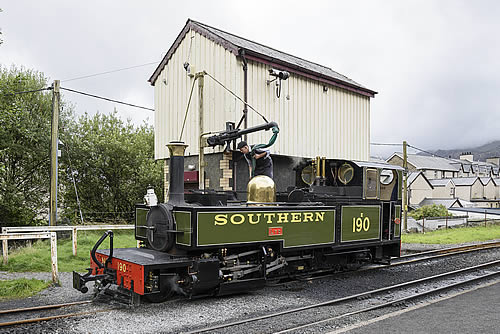
| Above: A delightful study of 'Lyd' taking water at Blaenau between passenger turns. The locomotive is based on the design of the (original) Lynton & Barnstaple locomotive 'Lew', which was ordered by the Southern Railway when it operated the line, and built by Manning Wardle in 1925. By the time the railway closed in on 29th September 1935, 'Lew' was still the newest locomotive, so was not scrapped likes its peers (all of which had been in service since 1898) but was used to dismantle the line. Afterwards, it was shipped overseas, probably to Brazil, and that's where the historical trail goes cold. If you want to follow up the mystery, the link here will help you – but its story also peters out. In brief, it seems very likely that 'Lew' reached Brazil, and also that it worked on a sugar plantation in that country; but we doubt that such a business would have kept detailed records – especially not for 80+ years! – and certainly not to the standard of those maintained by the old Southern. 2nd September 2016. (Chris Jennings) |
