

|
Menu
|
|
|
|||||||||||||||
|
|
|||||||||||||||
145
|
146 |
147 |
148 |
149 |
150 |
151 |
152 |
153 |
154 |
155 |
156 |
157 |
158 |
159 |
160 |
| National Cycle Network Route 1. One of the great things about the work of Sustrans over the last 20 years has been its re-use of disused railway lines around the UK before they could get completely 'beyond the pale'. Quite a few sections of old railway have found their way into NCN1, which is the charity's 'UK backbone' route from Dover to Shetland. Robert Greenall presents a selection of photographs from along its course. | ||
 |
||
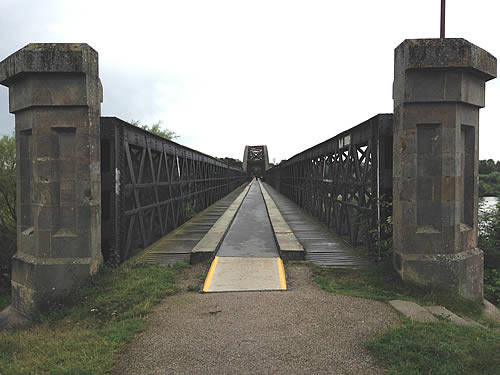
| Above: The Spey Viaduct, east of Garmouth, marks the start of a long coastal stretch of NCN1 which uses a high proportion of abandoned trackbed as far as Cullen. Apart from being part of NCN1, this section is also part of the Moray Coast Trail and the Speyside Way. 2015. (Robert Greenall) |
||
 |
||
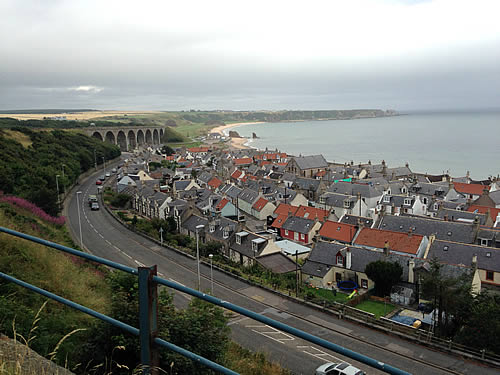
| Above: The fishing village of Cullen, on the Moray Firth. The viaduct is part of the Elgin to Cairnie Junction line, which winds over the village on a series of these fine structures. 2015. (Robert Greenall) | ||
 |
||
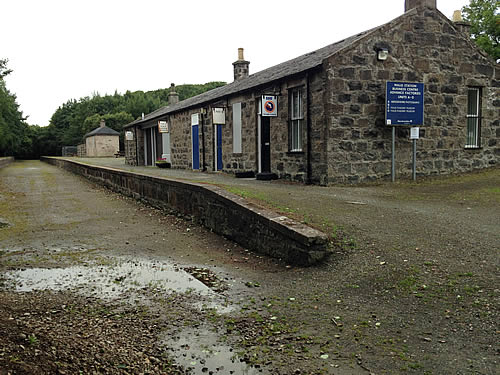
| Above: Maud, a remote but once thriving junction in north-east Scotland where trains from Aberdeen to Peterhead and Fraserburgh would diverge. This view of the Peterhead platforms looking towards Aberdeen shows industrial units, although there was no sign of the small railway museum said to occupy one of them. All three lines now form the Formartine and Buchan Way for cyclists and walkers. Maud is where NCN1 becomes a railway path once more for over 25 miles of traffic-free walking or cycling to Dyce, just north of Aberdeen. 2015. (Robert Greenall) | ||
 |
||
| Above: The St. Leonards branch in Edinburgh, one of Scotland’s first railways, is now known as the Innocent Railway Path. Its short length consists of this route alongside the crags of Holyrood Park and a dank tunnel which ejects users into the centre of the city. It is thought that the railway's safety record accounts for its unusual nickname: it carried between 300,000 and 400,000 passengers per year, without fatalities, at a time when railways could be very dangerous – a fact which Griff Rhys Jones discovered when he was the featured celebrity on 'Who Do You Think You Are?' The other explanation proposed for the name is the slow speed of the trains. 2015. (Robert Greenall) | ||
 |
||
| Above: Thorpe Thewles on the Stockton to Castle Eden branch line in Teesside and County Durham. This restored station is now a visitor centre for Wynyard Woodland Park and marks the start of the main section of the pretty Castle Eden Walkway. 2015. (Robert Greenall) | ||
|
||
 |
||
| Above: Closer to Scarborough is Ravenscar, a defunct station for a defunct town. At the turn of the 20th century, there were plans to develop this village as a resort to rival Scarborough. Sewers were laid and streets built, and a few new houses constructed; but it never took off, possibly due to the long trek to the village's rocky beach. Today, Ravenscar is a kind of ghost town; there are not many places in the UK where Station Road contains hardly a single house. 2015. (Robert Greenall) |

