

|
Menu
|
|
|
|||||||||||||||
|
|
|||||||||||||||
145
|
146 |
147 |
148 |
149 |
150 |
151 |
152 |
153 |
154 |
155 |
156 |
157 |
158 |
159 |
160 |
| The Moretonhampstead Branch. The GWR's branch line from Newton Abbott to Moretonhampstead closed to passengers on 28th February 1959, with freight services retreating southwards in stages to Bovey Tracey in 1964 and Heathfield in 1967, where – amazingly – a freight service survives to this day. Devon County Council is keen to re-develop the old trackbed north of Bovey Tracey as multi use trail, the Wray Valley Way, and currently one can walk or cycle 1½ miles from near the town's old railway station as far as a quiet lane that leads into the village of Lustleigh. At the north end of the line (not visited), about three-quarters of a mile of trackbed out of Moretonhampstead has been opened as a trail, which includes a new bridge over the A382 at grid reference SX 766852. | ||
 |
||
| Above: The delightful little station at Bovey Tracey has now been converted into the 'Bovey Tracey Heritage Centre', which includes some interesting exhibits from both the local branch line and the nearby Haytor Granite Tramway. The exhibits include an OO gauge model of the station in its heyday and some GWR uniforms. 13th June 2015. (Jeff Vinter) |
||
 |
||
| Above: This GWR Toad brake van, seen in the right of the picture above, contains a model of the branch terminus at Moretonhampstead, plus a selection of historic railway posters from the area. It is an 'incomer', having arrived from Llynclys Junction on the Cambrian Railways' line from Whitchurch, Shropshire, to Welshpool and beyond. 13th June 2015. (Jeff Vinter) | ||
 |
||
| Above: Just a few hundred yards north of Bovey Tracey station, the old railway crosses the River Bovey on this stone bridge. Bridges and viaducts are very much a feature of this line, for above Bovey the railway engineers encountered ever-rising hills which lead up to Dartmoor. 6th November 2014. (Bob Spalding) | ||
 |
||
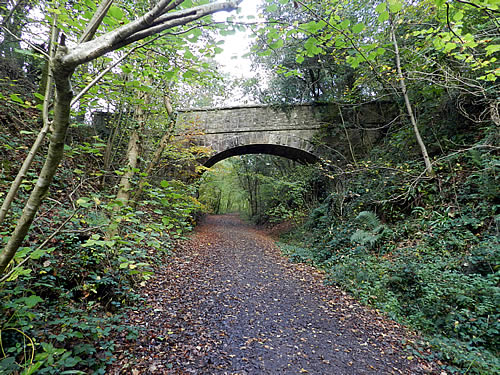
| Above: The old railway climbs steeply from Bovey Tracey to Lustleigh, the gradient being clearly visible in this photograph. Between Bovey and Wilford Bridge (grid reference SX 799797), two overbridges are passed, this being the first of them at SX 804791. Ever keen for a bargain, the railway opened a quarry at Lustleigh which supplied the granite for the line's bridges and viaducts. 6th November 2014. (Bob Spalding) | ||
 |
||
| Above: This is Wilford Bridge at SX 799797 which, until 2014, comprised two abutments without a span, the latter having been installed by Devon CC as part of its plan to develop the Wray Valley Way. This picture shows clearly that the abutments have been raised to allow vehicles such as removal lorries to pass below; the inability of the original to do this undoubtedly hastened its departure from this world! Notice that the council has extended the bridge in matching stone, which will not look so bright when it has weathered for a few years. 9th April 2015. (Jeff Vinter) | ||
 |
||
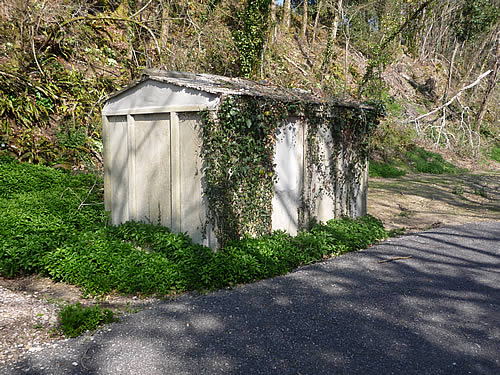
Above: Not far north of Wilford Bridge, this gangers' hut survives alongside the line. It was more normal for the GWR to construct these huts from timber, often from old sleepers – an early form of recycling. The example here will have had the advantage of not possessing walls preserved in bitumen. 9th April 2015. (Jeff Vinter) |
||
 |
||
| Above: This fine, skewed underbridge carries the old railway above Lower Knowle Road, which here becomes the official route into the picturesque village of Lustleigh. The bottom of trail from the trackbed is given away by the fencing which can be seen through the arch of the bridge on the right. 9th April 2015. (Jeff Vinter) | ||
 |
||
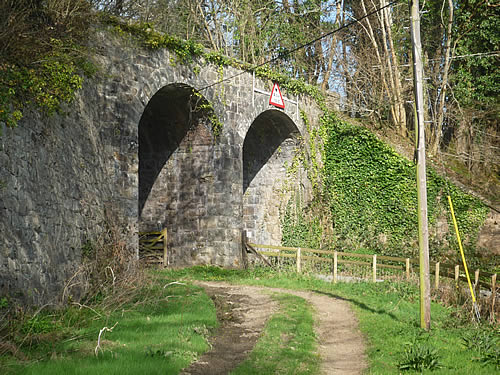
| Above: There are several viaducts between Bovey Tracey and Lustleigh, this one being situated at SX 790803 off Lower Knowle Road. The private track behind the photographer leads to a three-arch viaduct of similar type at SX 788804, which is not accessible to the public. 9th April 2015. (Jeff Vinter) | ||
 |
||
| Above: This, the last viaduct south of Lustleigh, is situated at SX 786808 on the east side of Mill Lane, which offers a convenient way of reaching the village while still being able to get an occasional glimpse of the old railway. While taller than the viaduct above, it is obvious that the two are of a common type. 9th April 2015. (Jeff Vinter) | ||
|
||
 |
||
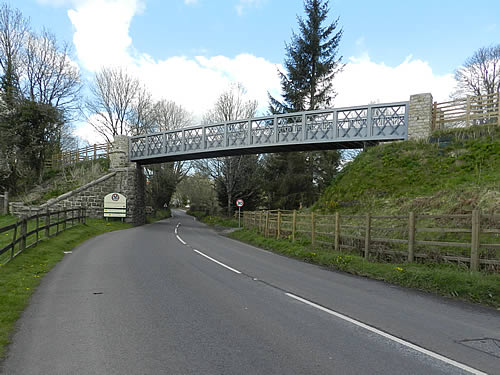
| Above: This is Devon CC's new bridge over the A382 at SX 766852 south of Moretonhampstead, which re-uses the original abutment on the west side of the road. As with the council's work at Wilford Bridge (see above), this is a high quality piece of engineering work, with even the piers at each end of the parapet constructed from stone which matches that of the old abutment. But why go to all this expense? Because a new bridge like this turns two sections of purposeless disused railway embankment into something that can be used again for the public good. April 2012. (Bob Spalding) | ||
 |
||
Above: An advert for the Manor House Hotel at Moretonhampstead from the ABC Railway Guide of August 1953. At this time, the guide showed six Monday to Friday services from Paddington to Moretonhampstead, with a change – as always – at Newton Abbott. The first class fares were advertised as 44/11d single and 89/10d return (£2.25 and £4.49 respectively), with the third class fares as 29/11d single and 59/10d return (£1.50 and £2.99 respectively). This was in the days when the railway charged just 50% extra for first class fares instead of whatever it can get away with. On the modern Great Western Railway, which is just the First Group under another name, the premium for first class travel can be anything up to 200%. (Jeff Vinter Collection) |
