

|
Menu
|
|
|
|||||||||||||||
|
|
|||||||||||||||
145
|
146 |
147 |
148 |
149 |
150 |
151 |
152 |
153 |
154 |
155 |
156 |
157 |
158 |
159 |
160 |
| A North Norfolk Miscellany (continued). Having travelled up the line from King's Lynn towards Hunstanton, we now reach Heacham, one time junction for the cross-country line to Wells-next-the-Sea – an early closure which lost its passenger service on 2nd June 1952. The line was built by the West Norfolk Junction Railway, which opened it in August 1866, but its timing could not have been worse, for that year saw not only the collapse of Overend and Gurney, a major railway banker, but also a 'cattle plague' in Norfolk which reduced the income from agricultural traffic. As a result, the line was absorbed in 1872 by the Lynn & Hunstanton Railway, which itself was swallowed up by the Great Eastern Railway in 1890. |
 |
| Above: These are the downside facilities at Heacham, which once offered rail services to Hunstanton and King's Lynn on the main line, or Wells-next-the-Sea via the branch. The owners let the old waiting room (which sleeps two) as holiday accommodation. 4th July 2015. (Rob Davidson) |
 |
| Above: The former station master's house at Heacham. The station was built about a mile west of Heacham village – actually closer to the beach than the village – so it is obvious that the railway hoped to derive business from the lucrative holiday market which developed in the 19th century.We are not sure if the level crossing gate is original, but it certainly looks authentic, perhaps all the moreso for not being perpendicular! . 4th July 2015. (Rob Davidson) |
 |
| Above: Like the old waiting room at Heacham, this converted ex-BR first class Mark I carriage (which sleeps four) can also be hired as holiday accommodation; for details, see www.oldstationheacham.com. Services to and from Wells operated from a bay platform on the east side of the station. 4th July 2015. (Rob Davidson) |
 |
| Above: The first station on the branch out from Heacham was Sedgeford, which an enthusiastic new owner is restoring – including the signal box – but this is a long term project requiring both dedication and resources. The station was situated about half a mile north of the village, which was fairly convenient as far as stops on rural byways were concerned. 4th July 2015. (Rob Davidson) |
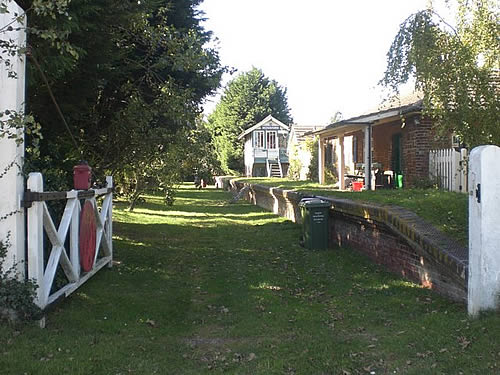 |
| Above: This earlier photograph of the station, taken from the public highway, shows the single storey station with a new canopy being constructed. The level crossing gate is a nice feature; like the one at Heacham, it looks authentic. Nigel Jones used under the terms of this Creative Commons Licence. (4th October 2007) |
 |
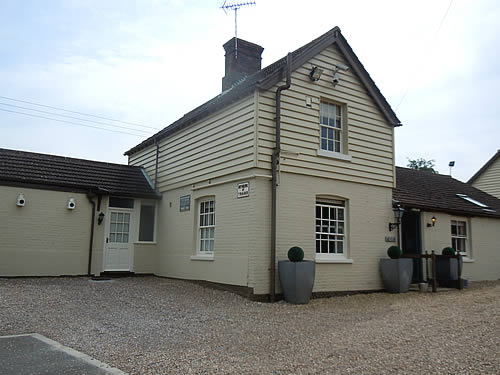
| Above: Three stations east of Sedgeford, the branch reached Burnham Market, where the station (at grid reference TF 836420) offers rented accommodation as an outpost of the The Hoste Arms, the town’s boutique hotel. It looks as if the platform canopy has been enclosed, while the weatherboarding on the upper storey may not be original, although it is doubtless necessary to keep out the winter weather. 4th July 2015. (Rob Davidson) |
 |
| Above: This is the side of Burnham market station which intending passengers would have seen when arriving to buy their tickets. The sign on the corner of the building reads 'Beware of Trains', but the one further along the wall to the left of the sash window comes from the Great Western Railway, which is a bit incongruous to say the least. Burnham Market was the largest community along the branch, but it wasn't very big in 1952, nor is it now. 4th July 2015. (Rob Davidson) |
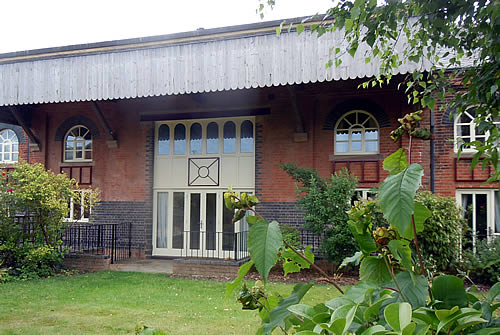 |
| Above: Small Burnham Market may have been, but it had a huge goods shed, as can be seen here. After passenger services were withdrawn in 1953, freight continued over the line until the North Sea flood of 1953, which damaged the section east of here between Holkham and Wells that British Railways deemed it beyond economic repair and closed it. After that, this became the terminus of westbound freight services to Heacham, which survived until 1963. The traffic was mainly coal for a local brickworks (inwards), and agricultural goods and locally caught fish (outwards). 4th July 2015. (Rob Davidson) |